...against fictions and other tall tales
Showing posts with label Indebtedness. Show all posts

Saturday, 20 April 2013

Inequality in the recent business cycle

This is a good speech by Governor Sarah Bloom Raskin of the Federal Reserve (also available in audio here). It was given during the Hyman Minsky Conference held at the Levy Institute earlier this week.

The speech focuses on the obstacles to recovery associated with household debt deleveraging and the decline in wealth for low-income households since the financial crisis. That low- and middle-income households held a disproportionate share of wealth in housing prior to the crisis meant they were highly exposed by the decline in house prices.

Raskin notes:
...[W]hile total household net worth fell 15 percent in real terms between 2007 and 2010, median net worth fell almost 40 percent. This difference reflects the amplified effect that housing had on wealth changes in the middle of the wealth distribution. The unexpected drop in house prices on its own reduced both households' wealth and their access to credit, likely leading them to pull back their spending. In particular, underwater borrowers and heavily indebted households were left with little collateral, which limited their access to additional credit and their ability to refinance at lower interest rates. Indeed, some studies have shown that spending has declined more for indebted households
Although later in the speech Governor Raskin discusses the Fed's strategy to address these issues (mainly by the use of unconventional monetary policies aimed at lowering long-term interest and mortgage rates), there is unfortunately no mention of the possible role of the Fed's current quantitative easing (QE) strategy in amplifying wealth inequality via the use of unconventional policies.

Since the start of the Fed's asset purchases programs (i.e., QE), we have seen stock indexes recover their losses while the decline in house prices has stayed flat (see charts below - Note: Increases in the monetary base is a good indicator of the magnitude of QE). In a context where the Fed is also hoping QE to sustain economic activity through the "wealth effect" channel (whereby a rise in asset prices causes investors to feel more secure about their wealth and, consequently, spend more), it's only normal to question whether current strategy is contributing (albeit unintentionally) to the wealth gap.

Source: Federal Reserve

Source: Federal Reserve

Tuesday, 26 March 2013

The BIS's new long series on private non-financial credit

The Bank for International Settlements has introduced a new data series on total non-financial credit (loans and debt securities) covering 40 economies and spanning an average period of 45 years. The new series are intended to improve comparisons between different countries and across time. One interesting aspect of these new series is that they account for credit from all sources, not only that extended by domestic banks.

Here is a short article that gives a good overview of the new series. It contains several BIS signature-style charts and, for illustration purposes, provides a look at the evolution of total private non-financial credit worldwide:
While total credit has generally risen substantially relative to GDP, levels and trends in private sector borrowing have varied across countries to a surprising degree. For instance, in several economies, total credit-to-GDP ratios already significantly exceeded 100% in the 1960s and 1970s. Equally, in a number of countries, the share of domestic bank credit in total credit has actually increased substantially over the last 40 years – that is, banks have become more, not less, important. And finally, sectoral breakdowns show that there has been a general shift towards more household credit. In some countries, households now borrow even more than corporates.

Friday, 22 March 2013

Is there a trade-off between employment and the household sector financial balance?

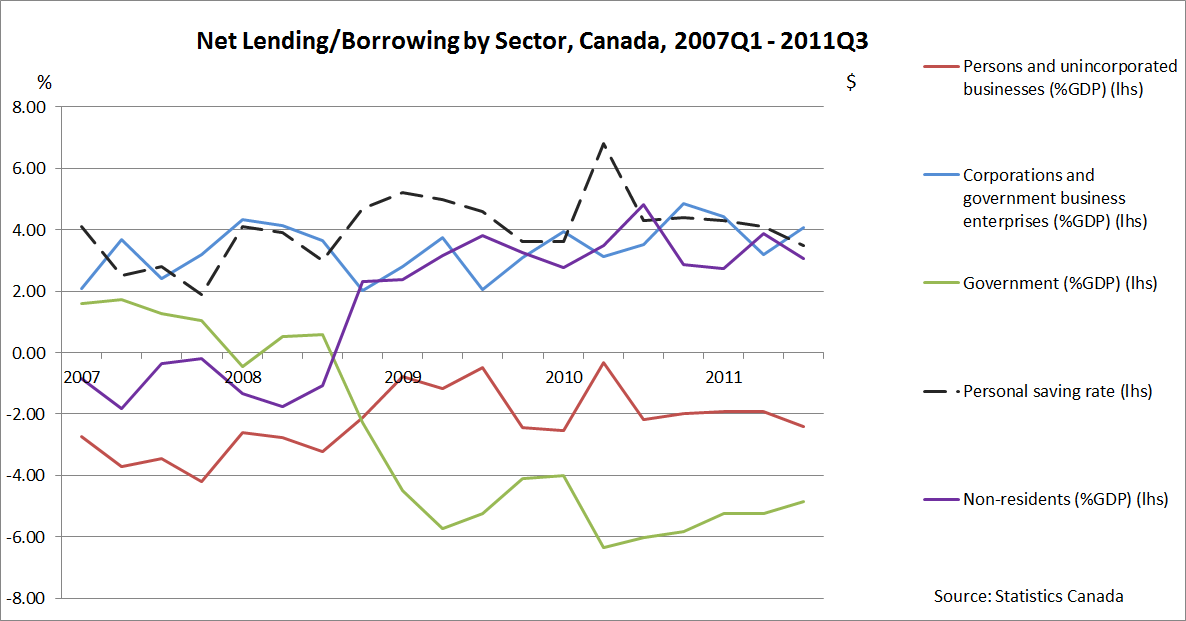
As Canadian policymakers try to get the household sector out of its financial deficit position, it's important to keep in mind that households are the sector that has been doing a lot of the heavy lifting in terms of boosting demand in recent decades.

Policymakers can attempt to get households to borrow less, but unless they can think of a way for another sector to offset the resulting reduced demand, it seems unlikely that the unemployment rate will remain at current low levels once households decide to reduce their net borrowing.

I posted these charts before but it's worth posting them again:

As household net borrowing increases, the rate of unemployment declines

A closer view of recent years

Sunday, 2 December 2012

Austerity in Canada: Then and Now

Canada's economic accounts for the third quarter of 2012 were released last week.  They show a very weak quarter.  Real gross domestic product barely stayed positive, growing by a mere 0.1 percent (see chart 1).  The details can be found here, courtesy of Statistics Canada (click on charts to expand).

Chart 1 Real GDP growth, quarterly % change

Many reasons have been given to explain the economy's weak performance, including the slowdown in China, the fiscal and financial situation in Europe, as well as tepid growth in the US during the summer months.

Of course, as usual, no one is pointing to the fact that Canada is currently undergoing its second most important (i.e., longest and sharpest) bout of public sector austerity in half a century.  One would think that commentators would highlight this reality in their analyses.

As you can see from the chart below, real (consolidated) government expenditure (excluding transfers) has been in decline since the fourth quarter of 2010.  Historically, such a decline in real government spending has only occurred once: during the period of fiscal restraint of the mid-1990s.

Chart 2: Real government expenditures, Source: Statistics Canada and author's calculations
The reason why commentators don't think of austerity as the potential cause of the current weak performance is that Canadians live under the illusion that government spending cuts have little or no impact on the economy.  This stems from the fact that the fiscal austerity put forth during the 1990s gave Canadians (and especially their political leaders) the false impression that cuts in government spending generally help to boost the economy.

Visually, this is how most commentators interpret Canada's experience with austerity in the 1990s (note: I'm not seeking to show a correlation between the two series. I'm simply overlapping both sets of data on a common timeline):

Chart 3: The vanishing deficit and the road to surpluses, Source: Statistics Canada
The standard view holds that fiscal austerity during the 1990s helped to shrink the deficit, thus enabling Canada to run a series of budgetary surpluses throughout the early- to mid- 2000s.  Also, this view holds that fiscal austerity played a crucial role in helping Canada recover from the recession of the early 1990s and contributed to Canada's strong economic performance during the period from the mid-1990s until the financial crisis. 

The problem with this interpretation is that it completely disregards the fact that the Canadian economy during the mid-1990s was impacted by a massive increase in demand stemming from the domestic household and external sectors.  Consider the following charts showing that, as fiscal austerity was undertaken, net borrowing by both the household and external sector exploded in Canada during that period:

Chart 3: Household sector falls into net financial deficit, Source: Statistics Canada and author's calculations

Chart 4: Increased foreign demand to the rescue, Source: Statistics Canada and author's calculations

Net borrowing is the difference between a sector's total spending and income.  It is a key indicator of the demand generated by any sector of the economy. 

Supported by a much easier monetary policy and falling exchanging rate (a consequence of US President Clinton's desire to "have a strong dollar"), the increased net borrowing generated by these two sectors was effective in offsetting the decline in net borrowing of the government sector caused by fiscal austerity.

The increase in net borrowing by the household sector between the mid-1990s and the mid-2000s was unprecedented.  Between 1995 and 2007, net borrowing by the household sector increased by close to 10 percent of GDP (see arrow going down).  As for net borrowing of the foreign sector, it increased by approximately five percent of GDP.  Combined, this additional demand was more than sufficient to offset the decline in demand caused by fiscal austerity.

Today, unlike in the 1990s, the household sector is seeking to reduce its level of borrowing.  And the foreign sector, due to the strength of the Canadian dollar and the weakness of the world economy as a result of global austerity, cannot be a significant source of demand at this time.*

As a result, any attempt by Canada's policymakers to balance the budget in such a context is self-defeating and actually exacerbating the problem given that it is taking away purchasing power from households and firms.  And, as we are witnessing now, it is taking its toll and slowing GDP growth as a consequence.

Economist James Tobin said it best several years ago:
Deficit reduction is not an end in itself. It's rationale is to improve productivity, real wages and living standards of our children and their children. If the measures to cut deficits actually diminish GDP raise unemployment, and reduce future-oriented activities of government, business and households, they do not achieve the goals that are their raison-d'être; rather, they retard them. This perverse result is likely if deficit reduction measures are introduced while the economy is as weak and as constrained by effective demand as it is now.
It's time to think more clearly about these issues.  What "worked" in the past need not be the appropriate course of action today.  The Canadian economy now is not like the one that existed back then.  It's time to move forward.  Trying to relive the "success" of the 1990s will only make matters worse. 

Update:

Chart 2 should be entitled "Real consolidated government expenditures (all levels of government) (millions of chained 2002 dollars)". The title and headings in charts 3, 4 and 5 are accurate.  All data comprises expenditures on goods and services, as well as on capital formation. They exclude transfers.


*  The critical point to remember is that, as I've explained before, the government deficit cannot be reduced in isolation from the other sectors of the economy.  Public sector deficits are from an accounting standpoint the equivalent of surpluses in the private sector, plus additional net imports.  The reason for this is that government deficit spending adds to the net accumulation of private holdings of households and businesses (and/or the foreign sector, where applicable).

In other words, any reduction in government spending or tax increase has a direct impact on the financial position of the private sector.  To believe otherwise is wishful thinking.  If external demand and/or increased demand from another domestic sector (households or businesses) are not high enough to offset the demand shortfall created by reduced government expenditures, continued attempts at fiscal austerity will impose additional deflationary pressure on the economy.

Reference

Tobin, J., "Thinking straight about fiscal stimulus and deficit reduction", Challenge, March 1, 1993

Saturday, 24 November 2012

The Federal Reserve staff on the evolution of US household net worth and related financial flows during the last decade

The Federal Reserve released an informative discussion paper this week that presents background on the Integrated Macroeconomics Accounts (IMAs) of the US.  The IMAs is a long-term interagency project between the Fed and the Bureau of Economic Analysis aimed at linking saving, capital accumulation, investment in financial assets and balance sheet data within an integrated framework using consistent definitions, classifications, and accounting conventions.

In the IMAs, each of the sectors of the economy is depicted according to a consistent set of statistical accounts: the current account (production and distribution of income accounts), and the accumulation accounts (capital, financial, other volume changes, and revaluation accounts).  These accounts allow one to trace the factors leading to changes in the net worth position on the balance sheet of each sector.

The paper contains lots of useful information for those interested in the analysis of national income and flow of funds accounts.

As a way to help demonstrate the usefulness of the IMAs, the authors of the paper have included a section describing the evolution of household net worth and its components during the last decade, thus enabling the reader to understand some of the underlying causes and subsequent effects of the recent financial crisis. 

As you read the excerpt below, keep in mind the following basic rule of thumb: a key indicator of the demand generated by any sector of the economy is its net borrowing (i.e., the difference between its total spending and income).
Uses of the IMAs
The recent financial crisis has vividly shown that analyzing the change in net worth and its composition is critical to understanding the health, risks, and prospects of an economic sector.  Net worth is a broad measure of the wealth of a sector, often used in conjunction with other variables, such as income and interest rates, to study variables such as consumption and saving.
The IMAs enable one to analyze net worth and its composition, clarifying how the current balance sheet position came about by distinguishing between saving, borrowing, holding gains or losses, and other changes in volume.  As an example, we can look at the IMAs for the household and [Non-Profit Institutions Serving Households] sector.  In the first half of the last decade, the household sector shifted from being a major lending sector to a major borrowing sector, rivaled only as a borrower by the federal government sector. It was at this same time that the rest of the world sector became the predominant lending sector.

At the same time, household net worth surged rapidly and the ratio of household net worth to disposable personal income reached record levels (chart 1 -- click on chart to expand).  This surge was caused not by elevated savings, but by sizable capital gains both on housing wealth and on stock-market wealth (chart 2).
Chart 1

Chart 2
Indeed, the ratio of both housing wealth and stock market wealth to disposable personal income surged to historically unprecedented levels (chart 3).  Not surprisingly, household debt also ballooned.  The ratio of household debt to disposable personal income surged from around 90 percent at the beginning of the decade to an all-time high of around 130 percent in the middle of 2007 (chart 4).
Chart 3

Chart 4
This ratio dropped to 111 percent by the end of 2011 as consumers borrowed less and as a significant amount of mortgage debt was written off. [...] [T]he household sector shifted back to being a major net lender in 2008.
Net borrowing by the federal government, on the other hand, ballooned to over $1.3 trillion in both 2009 and 2010. In 2009, the rest of the world sector was a significant lender, along with the financial business sector. The nonfinancial corporate business sector, traditionally a net borrower, became a net lender in 2009, as capital expenditures remained relatively low and retained earnings elevated (Cagetti et al, 2012:6-8).

Reference

Cagetti, M., Elizabeth Ball Holmquist, Lisa Lynn, Susan Hume, McIntosh and David Wasshausen, The Integrated Macroeconomic Accounts of the United States, 2012-81, Finance and Economics Discussion Series Divisions of Research & Statistics and Monetary Affairs Federal Reserve Board, Washington, D.C.

Sunday, 16 September 2012

Another round of QE: More of the same?

I once had a boss who always asked for briefing material of "no more than 100 words". He'd also say "Give me charts, please. Charts!" Here's a snapshot of what he would get if I was asked to update him on the effect of the Fed's quantitative easing (QE) strategy.

Recall that the Fed implements QE by buying financial assets from banks and other private institutions in the aim of putting downward pressure on yields and thus reducing interest rates. QE as a policy measure is easily identifiable in charts since it increases massively the amount of excess reserves in the banking system.

Given that Chairman Bernanke announced a new round of QE last week, I thought these charts might be of interest.* Not all of these indicators are related to QE's stated objectives. Still, given the centrality of QE in the Fed's overall strategy, I think it's useful to include them.

So, to summarize, since the start of QE, bank lending standards have returned to normal...


...business loans have rebounded, though not at pre-QE levels...


...the rate of increase in manufacturers' new orders has normalized...


...corporate profits have continued to rise well beyond pre-QE levels...


...the cost of borrowing for businesses (as reflected in the rate of 10-year inflation protected securities) has come down...


...as did the 30-year conventional mortgage rate...


... and stocks have recovered.
 

On the other hand, home prices have remained depressed...


...the employment-population ratio has flattened...


...and, finally, the rate of unemployment is still stubbornly high.


In a speech earlier this year, the President of the San Francisco Fed, John Williams, called the level of unemployment in the US a "national calamity that demands our attention". From the charts above, it's clear that another round of QE is unlikely to do much to help create more jobs moving forward.

* All charts and data are from the St. Louis Fed, FRED.

Wednesday, 12 September 2012

Joseph Stiglitz on low interest rates as the cause of the crisis

Joseph Stiglitz takes on the argument that low interest rates caused the subprime crisis. It appears to be an old clip but I'm adding it to the file.


And, as I've noted previously, Robert Shiller agrees with Stiglitz on this.

Similarly, Barry Eichengreen also makes a great point when he argues that it's not only borrowers' frenzy for easy credit that's to blame for these types of problems. This is what Eichengreen has to say about who's at fault for the current European mess:
I’m not too big on the language of culpability. But it takes two to tango. For every reckless borrower there is a reckless lender. The Greeks may have borrowed too much, but someone lent them all that money. German banks and those who regulated them clearly played some role in the crisis.
See here for a more detailed analysis on the role of low interest rates during the lead up to the US subprime crisis.

Friday, 1 June 2012

Canada: Government deficit shrinks, Household sector deficit soars

Canada's first quarter 2012 National Income and Expenditure Accounts were released today.  Here's a brief summary, courtesy of Statistics Canada:
Real gross domestic product (GDP) rose 0.5% in the first quarter, the same pace as in the previous quarter. Business investment contributed the most to first-quarter GDP growth. Final domestic demand grew 0.3%. On a monthly basis, real GDP by industry edged up 0.1% in March.

As was the case throughout 2011, business investment continued to fuel growth. Business investment in plant and equipment advanced 1.2%, the ninth consecutive quarterly increase. Housing investment expanded 2.9%, well above the previous quarter's pace of 0.8%. Non-farm business inventories increased in the first quarter.

Consumer spending on goods and services, another main contributor to GDP growth in 2011, slowed to 0.2% in the first quarter of 2012, after a 0.7% gain in the previous quarter.

In the first quarter, final domestic demand advanced 0.3%. Growth in final domestic demand has been slowing since the first quarter of 2011. Average quarterly growth in final domestic demand was 0.5% in 2011, following 1.1% in 2010.

While exports have been increasing since the second quarter of 2011, they remain below the level reached in the third quarter of 2008. Exports grew 0.6% in the first quarter of 2012, after gaining 1.7% in the previous quarter.

Imports rose 1.1% in the first quarter, almost double the pace of the fourth quarter of 2011.
Growth of real gross domestic product and final domestic demand, Source: Statistics Canada

Two things. First, although the increase in employment in March and April will surely boost consumer spending in Q2, it's very unlikely that the economy will improve markedly for the remainder of the year.  The current slowdown in the US economy and weak European prospects will likely weigh down on both exports and business investment. Second, additional government cutbacks will continue to remove much needed demand from the economy, weakening both employment and growth.

Finally, one important piece of information that the statistical agency isn't highlighting in its summary is the massive increase in the household sector deficit during the first quarter.  According to today's figures, the household financial deficit (i.e., net borrowing or difference between quarterly sectoral spending minus revenue) increased by over $7B during Q1 ($42.5 to $49.4 B).  This is the highest level since the third quarter of 2008.  As for the public sector financial deficit, it has narrowed by approximately $9B ($66.6 to $55.1 B).

Source: Statistics Canada
In a previous post, I explained that the inverse relationship between the government sectoral balance and household sectoral balance is evidence that the goal of public sector deficit reduction is incompatible with the objective of eliminating the household sector financial deficit, one of the key priorities of the Governor of the Bank of Canada, Mark Carney.  More on this theme in my next post.

Thursday, 17 May 2012

Interview: Raymond Lombra on the US economy and economic policy

The optimism about the US economy that took hold earlier this year is fading.  Consumer confidence fell last week to the lowest level in four months and the US job market is weakening, as evidenced by the higher than expected number of unemployment claims.  And on the stock market front, the month of May has been a disappointment as major US indexes fell back to levels not seen since January.

One economist who did not expect 2012 to be very different from last year is Raymond Lombra, a Professor of Economics at Penn State University and former Fed staff economist.  In an interview last September, Lombra explained to host Peter Schiff that the US economy's "lack of momentum" was set and that there was very little that the US fiscal and monetary authorities could do in the short-term to improve the situation.  Rather, Lombra's take is that the US government should continue to support aggregate demand to ensure the recovery takes hold and focus on promoting long-term growth and stability.

I highlight the views of Lombra for three reasons.  Firstly, there are very few people in the US who know more about the banking system, central bank operations and economic policymaking overall than Lombra.  Secondly, the views expressed by Lombra in the interview are strikingly similar to those of Chairman Bernanke in his February 2, 2012, testimony before the House of Representatives' Committee on the Budget, one of Bernanke's better performances in recent months.  Here is an important excerpt from Bernanke's testimony entitled The Economic Outlook and the Federal Budget Situation:
Even as fiscal policymakers address the urgent issue of fiscal sustainability, they should take care not to unnecessarily impede the current economic recovery. Fortunately, the two goals of achieving long-term fiscal sustainability and avoiding additional fiscal headwinds for the current recovery are fully compatible--indeed, they are mutually reinforcing...[A] more robust recovery will lead to lower deficits and debt in coming years.
The last reason why I'm highlighting this interview is that the exchange between Schiff and Lombra is actually quite interesting.  Although Schiff interrupts Lombra throughout the interview, I thought Lombra did a good job in refuting the radical views of the host.  Lombra covers a lot of ground in his responses and provides some very good insight on economic policy, the state of the US economy and on ways to improve the current economic situation. 

The interview is dated September 22, 2011. Here is also the transcript of the interview:

Peter Schiff: Joining the conversation is Dr. Raymond Lombra. He is a Professor of Economics at Penn State University. He is Associate Dean of Research and College Advancement. He is a former Associate Professor of University of the District of Columbia and George Washington University. He is also a former staff economist at the Federal Reserve Board of Governors. He has actually consulted with the US Banking Committee in Congress, the Federal Reserve, the Congressional Budget Office, the US Congress Joint Economic Committee, the IMF, the Senate Banking Committee and the US Treasury. Dr. Lombra, welcome to the show. 

Raymond Lombra: Morning Peter.

PS: So have you consulted with anyone in Congress or at the Fed recently?

RL: Well, I’d say informally with various staffers and I also consult with some Wall Street firms. But just because they talk to us doesn’t mean they follow the advice they get! (laughter)

PS: Ok, so then it’s not your fault if they are not following your advice. They are ignoring it! (laughter)

RL: Yes, but I’m not saying we have the right answers either.

PS: What is your advice? I mean, I just went before Congress last week to testify on what they can do to help the economy, or more importantly, how they can stop hurting it. But what is your advice? What are you telling Congress and the Fed? What should they be doing right now?

RL: Well, I think we need to dial back a little here. We’ve obviously entered the "silly season" – the run up to the next election. And you can ask yourself “what reasonably can be accomplished over the next thirteen months?” And I think a lot less than people are imagining.

PS: Well, I don’t think we should be pursuing monetary and fiscal policy with the goal of an election in mind. Our leaders need to be thinking longer term.

RL: Oh, I agree with that. But we know that – more the Congress and the President, of course, than Ben Bernanke and his colleagues – they certainly are fixed on the next election. As you are suggesting, this is going to lead to bad policy. I mean, the whole idea of setting the Fed they way they were set up was to give it the freedom to act in the best long run interest of the nation even if not in the best short run and political interest of its elected leaders.

PS: But it never seems to do that. It always seems to try to re-elect who the incumbents are. That’s generally how they pursue policy.

RL: I think there have certainly been periods like that. And I don’t know if you want to turn this into a discussion about Ben Bernanke, but I’m sure you’ve talked about the Republican’s letter to him in front of the Federal Open Market Committee. I mean, he’s worried about the economy and the question is “what, if anything, can the Fed do?” Well, I would say that the actions they took yesterday are pretty modest. I think that if we got him hooked up to a lie detector and said “do you really think this alone, these two actions that were announced, are going to make a big difference?”, he would say “probably not”.

PS: Well, I think if we hooked him up to a lie detector, it would probably break due to the excess activity. (laughter) You know, I think he’s going to ultimately give the market what it wants, which is more money from helicopters because this economy is imploding. The problem is that they are trying to resurrect a Frankenstein economy. We have to let the US economy die so that a real one can be born to takes its place. We can’t try to preserve an economy by just spending borrowed money. That’s what the Fed is trying to do and it won’t work. Meanwhile, the banks that were bailed out before are all going to fail. So what’s the Fed going to do? Is the Fed going to let them fail this time?

RL: Well, you’ve covered a lot of ground there. I would say that Ben Bernanke knows more than most people on the globe about both the Great Depression and, I would say, the lost decade in Japan. And I think the common threads he draws from those experiences is that it is worth trying something even if in retrospect they didn’t do much good as opposed to doing nothing. And history is going to have to be the judge about which specific initiatives made a difference. But I do want to go back a little bit because there is a tendency to look at what’s happened in the United States over the last few years as akin to a normal recession. The way we talk to our students about it is the economy catches a cold or maybe even the flu. When to my mind what the economy suffered was more like a stroke and we know that the recovery from stroke can be long and it’s going to take a lot patience and attention to long run therapies. But unfortunately our political system is not very patient.

PS: I think the problem is that every time we actually caught a cold in the past, the way the government cured it was just to cover up the symptoms and let us get sicker. And now we’re so sick from all these prior government stimuluses that this last one is actually the one that’s going to kill us. And that’s why the economy is dying because the government continues to administer the toxic medicine that prevents the free market from healing itself.

RL: Well, I certainly agree that, if we took the stance that policymakers are kind of out of short run remedies, this may be a good thing. The question is whether the longer run adjustments in taxes and expenditures and regulations, in particular, on the fiscal policy side can create a more stable environment for businesses and consumers to make good decisions. And there’s really not much hope that any of that is going to happen in the next fourteen months unless the economy slides a lot more than most consensus forecasters see it at the moment.

PS: Listen, I think we’re in a recession already because I think we’re in a depression. So I don’t think it ever ended and I don’t think it’s going to end. I think it’s going to be with us probably for the balance of this decade because I don’t know that the government is ever going to do the right thing. I think they are going to keep on stimulating and we’re never going to get out of this and we’re just going to dig the hole deeper.

RL: Part of it is maybe instant analysis and the 24/7 discussions and the way politicians can get trapped sometime by saying things that maybe in the more full reflection they don’t really believe. But it seems to me that we’re in an environment where, just to take one example, this discussion about “should we or shouldn’t we raise taxes on the rich”. If we stopped the average person on the street – I’m guessing, I think it’s true – that the President and most of the Democrats understand that the wackiest thing you could do between now and when the economy were to regain its feet would be to raise taxes. But that nuance, it gets to be a discussion about raising taxes now and cutting Social Security benefits and Medicare. That would be crazy. I think what the markets are looking for – and I’m guessing what you’re imagining the economy needs – is a path to a more sustainable fiscal environment. And the path would have to be sensitive to where we’re starting from. The great mistakes that were made in the Depression were that we allowed aggregate demand to contract even as it needed to be boosted. We need to avoid that.

PS: Well, I would disagree with that. I think we’ve had too much demand. We bought things we couldn’t afford. That’s the problem. We need more savings. We need to produce more. But the whole thing on taxes and the problem with our economy is not that the rich aren’t taxed enough. The rich are paying plenty of taxes. But when people object to raising taxes in a recession, they do that because it takes money away from individuals. Well so does government spending. The problem is that when you run a deficit as opposed to raising taxes, this damages the economy even more than the taxes. So if politicians are worried about draining the economy of resources from taxes, they really need to be worried about draining the resources from government spending. So what we really need right now is massive cuts in government spending. That’s the only stimulus that going to help: massive cuts in government spending!

RL: Yeah, I would disagree that that is the route out of this – where we are right now today. I think that over the longer run, there’s no question that government spending is too large. You know, Milton Friedman certainly understood that actually the route to long run prosperity was to cut spending for reasons... (inaudible).

PS: Then, how do you think we get out of this? We run big deficits? Let the government spend a bunch of money? I mean, how does the economy recover?

RL: I don’t know any economist – well, I shouldn’t say that. Most economists, rational economists, believe that we need a lot more fiscal discipline over the longer run than we’ve seen.

PS: But we don’t need any now?

RL: The question is how you get there.

PS: But what about right now? What do we need to do right now? What should the fiscal policy be right now? What should the monetary policy be right now?

RL: I don’t think the Fed could or should do much more than it’s done already. We got plenty of liquidity in the system and a little tick down in interest rates isn’t going to make any difference. As you know, it’s small businesses and consumers that can’t get access to credit for a lot of reasons, including the aftermath of the 2007 recession.

PS: Right, but the last thing we want is more consumer credit because we don’t want more spending on borrowed money. We want that credit available for investment and production. So, that would be a bad thing is consumers got more credit.

RL: Well, consumers are rebuilding their balance sheets and what you’re suggesting is that the government needs to rebuild its.

PS: Absolutely.

RL: And I agree with that over the longer run. But I think cutting aggregate demand right now would be exactly the wrong policy. On the other hand, laying out a path, and I’ve seen a lot of different plans. And certainly the deficit reduction committee – the earlier one and the one that is operating now – understand both the need for a path and the general outline of what it’s going to involve. The question is: “Is the political will there to do it?”

PS: But what you’re suggesting is to make that path more difficult. You’re saying we have to run bigger deficits now so that we can tackle the deficits later. But the bigger we make them now, the more difficult it is and the less likely we’re ever going to tackle them.

RL: Well, I don’t think you asked me what I would do on fiscal policy today.

PS: I did ask you. What would you do?

RL: My first order of business would be to lay out the path to fiscal balance over the next five to ten years. That would be the first thing I would do.

PS: We’re going to have to hold that thought until after the break. But I would like to know what we’re going to do about the deficit this year, next year, right away, not the path of the future because we can’t force Congress to follow that path. What counts is what we actually do right now. Think about that and we’ll be right back.

(Break)

PS: So not about a plan for the future, what do we do right now. What does Congress do for this current fiscal year, if anything to make the economy grow?

RL: Well, I would say “damn little” that they can do to improve the economic performance over the next year. I would say that because a lot of the momentum – or lack thereof – is already set in place, I think that we are going to be given a lot of false hope by some. I would have thought we already learned the lesson that there aren’t really such things as shovel-ready projects. So we’re hearing more about infrastructure – I guess the President today was going to be at some bridge in Kentucky saying that this is what we can fix up. But what we’ve learned is that by the time Congress enacts something until a job gets created is a very long time and it has much smaller impact than were envisioned at the time that the policies were pushed. I think that is not the route forward for the next fourteen months. I think extending the payroll tax cut won’t hurt and could help. But I think the most important thing that Congress can do is get together on a longer run framework for cutting spending and, I think, adjusting tax revenues. We can debate whether it should be closing loopholes and lowering rates but we need to be able to adjust the revenue.

PS: But how do they do anything long term when whatever they pass today is not binding on any future Congress? Whatever they do can be undone.

RL: That’s a really good question and I’ve thought about that. You know, political scientists have looked at whether term limits would make a difference. I remember when I was back in Washington for quite a while the Gramm-Rudman-Hollings budget rule that was put in place did have some significant impact on retaining spending. And looking back on that kind of approach might make some sense.

PS: It couldn’t have worked too well because we got rid of it. That was part of the problem, right? We got rid of it.

RL: I think it did restrain spending relative to what it otherwise would have been and then it got abandoned so let’s learn from that. This time around the committee that is meeting knows that if some agreement on deficit reduction isn’t made there will be very large cuts to the military. And some of them are not too happy about that. So there may be a lever that’s been uncovered here that helps bring some discipline over and above what rule they agree to. There are institutional arrangements that have to be adjusted here. There isn’t an argument that you’re going to make or that I’m going to make that by itself is going to change the path to fiscal stability.

PS: I think big cuts in military spending would be a good thing. So I just assume let them go through. I don’t think that would jeopardize our security. I think what is jeopardizing our security is all the money we’re wasting on excess military spending, among other things. But here’s the problem. See, if I’m right and the economy never recovers then how are they ever going to deal with these deficits? They are always going to say “we can’t raise taxes in a recession and we can’t cut spending in a recession”. And eventually, interest rates are going to go up because inflation is going to be such a problem that they are not going to able to stay down. And then what do we do? What do we do with all of this debt that is financed with T-bills when interest rates are going up? Is the government going to spend all of its money on interest and nothing on anything else or are we just going to turn the money presses full steam?

RL: Well, I think that’s a little extreme but I’m thinking that’s one of the reasons you recommend people be in precious metals. But I’m not as pessimistic as you are at the moment, I think.

PS: About what? You don’t think interest rates can go up?

RL: Look, as we’re speaking, the Dow is down (inaudible) points...(inaudible)

PS: You don’t think interest rates are even going to go up? No, I’m not talking about today...(inaudible)

RL: It’s floating though. It’s floating every day.

PS: Right, but I’m saying, let’s say over the five to ten years. Do you think interest rates are going to stay at these ridiculously low levels?

RL: No, of course not.

PS: Alright, so what happens when they go up to a normal level? The government can’t afford to service the national debt with normal interest rates, let alone high interest rates.

RL: Well, not if you hold everything constant. But everything else is hardly ever constant.

PS: What do you think is going to happen? Are we going to have enormous economic growth that’s going to make these huge deficits financeable at higher levels of interest?

RL: Not with the current set of policies we have in place.

PS: Right. But we could have higher interest rates. We could certainly have a big pick-up in inflation. What if the Chinese decide to...(inaudible)?

RL: I wouldn’t expect that to happen until aggregate demand strengthens considerably.

PS: What about aggregate demand in China? What if the Chinese come to their senses and let the dollar drop against the RMB and the Chinese currency were to sky-rocket in value and China was to go on a global buying spree?

RL: Well, that would be one thing that didn’t stay equal. We could list all sorts of things which would change the economic outlook and that would certainly be a significant one. And policy would need to be adjusted in light of that. And we’d have to hope and expect the Federal Reserve would extract a lot of the liquidity that’s in the system to deal with the inflation that was beginning to emerge.

PS: You keep focusing on this aggregate demand that we need the government to supply. All that government does supply is inflation. All they do is buy what’s been produced. They don’t increase supply. They just increase demand so prices have to go up, or prices are prevented from falling, which might be something that would help the economy. But just having government spend money isn’t going to grow the economy.

RL: Well, I think it’s a component of aggregate demand. It’s not the only source. We also have the consumer...(inaudible)

PS: But where does the government get the money? I mean, if the government spends it somebody else doesn’t have it.

RL: The consumer is the most important part of the economy, proportionally. The consumer is rebuilding its...(inaudible)

PS: Well, I would disagree because if nothing is produced what is he going to consume? Where is the consumer if there is no producer?

RL: Well, producers will produce when demand picks up.

PS: But there’s always demand. I mean, everybody “wants” things. The question is you have to be able to supply it. You have to be able to create it. There are all sorts of things that I’m sure you would like to have but don’t have because you can’t afford it. It’s not because you don’t have demand. You just don’t have the means.

RL: You’re trying to push me into a debate. This is an old debate: does demand create supply or does supply create demand? And the fact is that markets reflect both supply and demand. So that’s my position. I’m saying that, right now, the economy is operating well below its potential. Firms have less employees. Their plants are more idle than they would be in the face of a pickup in their orders. That’s just going to have to work its way out of the system.

PS: Yes, I think what is preventing them from producing is that they lack the capital. They can’t do it at a low enough price to produce goods that propose can afford.

RL: What capital? Firms are sitting on an enormous amount of funds right now.

PS: Well, funds...but that’s not a factory. Just because they have paper doesn’t mean they have a machine.

RL: Oh, there are very few firms today that will tell you they are not hiring because they don’t have more factories to put them to work in. There are a few but there aren’t many.

PS: But they can’t produce things at a competitive price that people can afford to buy. That is the problem. We have to restructure the economy. Hey, this is an interesting discussion. Maybe we can continue it on another program. Thanks for stopping by.

Sunday, 29 January 2012

Interest rates and the housing bubble

In a recent post, Prof. Krugman seems to suggest that the Fed's low interest rates were to blame for the bubble in housing. I side with Robert Shiller on this issue:
The interest rate cuts cannot explain the general nine-year upward trend that we have seen in the housing market. The housing boom period was three times as long as the period of low interest rates, and the housing boom was accelerating when the Fed was increasing interest rates in 1999. Moreover, long-term interest rates, which determine the rates for fixed-rate conventional mortgages, did not respond in any substantial way to these rate cuts until the late stages of the boom. (2008:49)
Visually, this is what Shiller is pointing to (click to enlarge):

Source: Federal Reserve


Now, you can blame the regulators (and their political leaders) for having failed to stem the flow of toxic mortgages by setting prudent mortgage-lending standards, as I did in an earlier column. But to suggest that the Fed's low interest rates created the bubble is not right. On this point, the Financial Crisis Commission made it very clear: excess liquidity did not cause the bubble; rather, it was the failures in financial regulation and supervision that are to blame, including the "failure to effectively rein in the excesses in the mortgage and financial markets". (2011:xxvi)

 References:

National Commission on the Causes of the Financial and Economic Crisis in the US, The Financial Crisis Inquiry Report, Public Affairs: New York, 2011

Shiller, R., The Subprime Solution, Princeton Press: Princeton and Oxford, 2008

Monday, 12 December 2011

BoC Governor Mark Carney: Growth in exports, government spending or business investment needed to eliminate the household net financial deficit

A quick post. The Governor of the Bank of Canada, Mark Carney, gave a speech today on the risks facing Canada and the world economies. While the speech contained many of the same themes covered in the December edition of the Bank's Financial Stability Report released last week (see here), a noticeable emphasis was placed on the issue of Canada's household indebtedness. This is not surprising given that Canada's 2011Q3 National Balance Sheet figures are expected to be released tomorrow.

From a Canadian standpoint, the most important part of the speech was when M. Carney's discussed the different ways in which the net financial deficit of Canada's household sector can be eliminated. According to M. Carney, the deficit of the household sector could be eliminated through a combination of export growth, government spending and business investment.

But it is clear from the speech that M. Carney would prefer that Canada's business sector, which is currently running a significant net financial surplus, take a leading role in helping to stimulate the economy while households are seeking to reduce their level of debt. This approach may sound familiar to regular readers of this website. Here is the relevant excerpt of the speech:
To eliminate the household sector’s net financial deficit would leave a noticeable gap in the economy. Canadian households would need to reduce their net financing needs by about $37 billion per year, in aggregate. To compensate for such a reduction over two years could require an additional 3 percentage points of export growth, 4 percentage points of government spending growth or 7 percentage points of business investment growth.

Any of these, in isolation, would be a tall order. Export markets will remain challenging. Government cannot be expected to fill the gap on a sustained basis.

But Canadian companies, with their balance sheets in historically rude health, have the means to act—and the incentives. Canadian firms should recognize four realities: they are not as productive as they could be; they are under-exposed to fast-growing emerging markets; those in the commodity sector can expect relatively elevated prices for some time; and they can all benefit from one of the most resilient financial systems in the world. In a world where deleveraging holds back demand in our traditional foreign markets, the imperative is for Canadian companies to invest in improving their productivity and to access fast-growing emerging markets. (emphasis added)

Wednesday, 7 December 2011

Functional finance, public capital budgeting and the productivity-enhancing role of public investment

I really enjoy the interviews that the folks at the Institute for New Economic Thinking (INET) have been producing recently. They provide a quick and easy way of learning about new and different approaches to economics.

One interview that I think is particularly interesting from a policy standpoint is the one with economist Mario Seccareccia of the University of Ottawa. The topics discussed during the interview include the pre- and post-crisis approaches to fiscal and monetary policy, functional finance, the financial flows view of macromanagement, public capital budgeting and the productivity-enhancing role of public investment.

Needless to say, I believe the issues discussed in this interview are of fundamental importance to the modern practice of economic policymaking. The part of the interview that I found most interesting is when M. Seccareccia explains the importance of public investment, and the critical role it plays on enhancing productivity.

For those who are interested in knowing more about public capital budgeting, I recommend this excellent short paper by the late economist Richard Musgrave, a pillar in the area of public finance. R. Musgrave's ideas are discussed during the interview.

Reference:

Musgrave, R., "Budget Balance and Sound Finance"

Saturday, 3 December 2011

Canada's 2011Q3 Economic Accounts: federal deficit increases, saving rate drops, growth in real PDI flat

This is a quick post to go over this week's release of Canada's 2011Q3 Economic Accounts and November's Employment report. The title above says it all but here is some added insight.

The increase in the federal government's deficit will no doubt disappoint the federal Minister of Finance, Jim Flaherty. While a growing deficit is a positive development for the economy, as it provides for additional purchasing power, it is very likely that the Minister will attempt to deal with the enlarged deficit by augmenting the level of expenditure cuts he is planning for the upcoming year. Budget plans for next fiscal year are currently being drawn up in Ottawa. Increasing cuts to public expenditures would only worsen the situation and come at a bad time for the economy.

The drop in the saving rate from 4.1 to 3.5 percent will discourage the Governor of the Bank of Canada, Mark Carney. Since early in the recovery, M. Carney has been trying to persuade Canadians to ramp up savings and pay down debt. I doubt that M. Carney still believes this is possible for the near-term: real disposable income has slowed considerably since mid-2010 and Canada's labour market is not faring well at present. And add to the mix the contractionary effects of fiscal measures aimed at reducing the deficit and it is likely that the saving rate will remain low throughout the next year.

Click on image to enlarge


Finally, the unemployment rate increased for the second month in a row. It now stands at 7.4 percent, only 0.2 percent lower than in November 2010. With government spending about to decline, business investment down in the third quarter and final domestic demand flat, it is hard to be optimistic about the job market moving forward.

Unemployment rate, Source: Statistics Canada


Addendum 

Click on image to enlarge

Saturday, 26 November 2011

Deficit myths (Part 3): The effect of budget deficits on business profits

Martin Wolf is right in saying that government fiscal tightening will hurt business profits. As Wolf correctly points out: "In order to reduce huge government deficits, surpluses must fall elsewhere".

For the UK, this means that the only way the government can succeed in balancing its budget is if the reduction in the government deficit is offset by a reduction of equivalent magnitude in the surplus of at least one other sector of the economy (i.e. household, corporate or foreign sector). And according to Wolf, the surplus sector that is most likely to be affected by the government's plan to reduce the deficit is the corporate sector because, at the moment, the household sector is not willing to incur additional debt (and fall back into deficit) and UK exporters are unlikely to reverse the flow of wealth currently exiting the UK economy (thereby reducing the surplus of foreigners).*

In a way, Wolf could just easily have argued that, in the UK right now, it is the government deficit that is enabling the corporate sector to run a surplus. And when households are deleveraging and exports are declining, business profits can only be realized if the government runs a deficit. Thus, by cutting the deficit, the government is in effect reducing an important source of business profits.

Proof of this direct, positive relationship between government deficits and business profits is best demonstrated by manipulating the basic national income accounting identity in a manner consistent with the approach of economists John Maynard Keynes and Michal Kalecki. The following arithmetic demonstrates that government deficits have a positive effect on business profits.

Let Y=Total Output; C=Consumption; I=Investment; G=Government Expenditures; X=Exports; M=Imports; T=Taxes; R=Retained Earnings by Firms; Hs=Household Net Savings

Let the combination of the above (X - M) = Current Account Balance or Net Exports; (G - T) = Government Deficit; (Hs + R) = (Y - T - C) = Total Net Private Savings

To start off, here is the basic national income identity, as taught in all macroeconomic textbooks:
Y = C + I + G + (X - M)

Subtract taxes (from both sides of the equation) to achieve an equation "net" of taxes:
Y - T = C + I + G + (X - M) - T

Rearrange the equation to isolate total net private savings on the left side and to subtract taxes from government expenditures:
Y - T - C = I + (G - T) + (X - M)

Since (Y - T - C) can be broken down into household net savings (Hs) and retained earnings by firms (R), the equation can be stated as follows (see Krugman, 1994:313):
(Hs + R) = I + (G + T) + (X - M) 

...and can be rearranged as such:
R = (I - Hs) + (G - T) + (X - M)

In plain English, this translates into:
Firms' Retained Earnings = Investment - Household Savings + Government Deficits + Net Exports

The above equation clearly demonstrates that business profits are positively impacted by government deficits, net exports and private sector investment.* Household net savings, on the other hand, have the effect of reducing firms' retained earnings. Similarly, balanced budgets and government surpluses have either no impact on profits or have the effect of reducing them.

One objection to this line of reasoning often invoked by economists is that government deficits increase the level of private sector savings (as households and businesses reduce consumption in anticipation of future tax increases). This claim is known as the Ricardian Equivalence proposition. However, there is little empirical evidence that this claim holds true and that the impact of government deficits gets neutralized (or offset) by a corresponding increase in private sector savings. As Douglas Bernheim argued in his seminal work on the topic:
...the case for long-run neutrality is extremely weak, in that it depends upon improbable assumptions that are either directly or indirectly falsified through empirical observation...[B]ehavioral evidence weighs heavily against the Ricardian view (1987:213)
To conclude, it should be emphasized that the purpose of economic policy is not to enable firms to realize profits, but to maximize employment and ensure that the product of industry is beneficial to the overall economy. Business profits, by creating an incentive for firms to invest and employ available resources, can help to promote these objectives. In the above analysis, my aim is to show that government deficits cannot be looked at in isolation from the financial positions of other sectors of the economy. Whether it is to stabilize aggregate demand or to provide for much needed public goods, deficits serve an important purpose. Attempting to reduce government deficits without considering its impact on the overall economy is not a sound basis for policy.

* Paul McCulley provided a similar analysis (2010).
** A different, yet equally effective approach to examining the relationship between profits and government deficits is found in Levy et al. (2008:16).

References

Bernheim, D., "Ricardian Equivalence: An Evaluation of Theory and Evidence", NBER Macroeconomics Annual 1987, S. Fischer, ed., Vol. 2, pp. 263-316, (Mass: MIT Press), 1987

Krugman, P., International Economics: Theory and Policy 3rd Ed., (New York:Harper-Collins), 1994

Levy, D., et al., Where Profits come from? Answering the Critical Question that Few Ever Ask, The Jerome Levy Forecasting Center, LLC, 2008

McCulley, P., Facts on the ground, Policy Note, Levy Institute of Bard College, 2010

Sunday, 2 October 2011

Stephen Harper, David Cameron and the illusive dream of austerity

Last week, Canada's Prime Minister, Stephen Harper, and his British counterpart, David Cameron, joined forces to urge world leaders, especially those of European nations, to embrace austerity as a way to avoid tipping the world economy into recession.

According to Harper and Cameron, cutting government expenditures is the only way to fix the national economies of Europe and the United States, and restore confidence in the market. Excessive debt, they say, are to blame for the current problems now affecting several European countries. And the best way to remedy these problems, they conclude, is for nations to deliver on their promises to impose austerity measures and implement budget cutbacks on government expenditures.

In my view, there are a number of problems associated with this course of action. Firstly, from a historical standpoint, it should be emphasized that austerity has been found to be associated with positive economic performance in only a minority of cases where it has been attempted. For instance, an IMF study authored by C.J. McDermott and Robert Wescott concluded that fiscal retrenchment was accompanied by improved economic conditions in only 19 percent of the relevant episodes occurring between 1970 and 1995 (1996).

Also, more recently, a study by Alberto Alesina and Sylvia Ardagna found that the combination of austerity and growth occurred in 25 percent of the relevant episodes recorded by the OECD between 1970 and 2007 (2009, Data Appendix:Table A2).

In other words, both studies demonstrate that the odds of successfully reducing public debt levels and achieving increased growth through austerity are not very good.

Secondly, austerity rarely leads to improved economic conditions solely as a result of fiscal retrenchment by government. Most often, successful public sector austerity campaigns are the outcome of the combined effects of monetary policy and exchange rate policy, as well as the positive impacts of external economic conditions.

For instance, Canada's experience with austerity in the mid-1990s could be viewed as positive largely because of the change in US exchange rate policy announced in April 1995. As I explained in a previous column, this change in US exchange rate policy
...resulted in the rise in the value of the US dollar against other currencies. The ensuing depreciation of the Canadian dollar provided a huge boost to Canada's exports, and helped Canada achieve several years of consecutive current account surpluses.
In the case of many European countries today, austerity cannot benefit from changes in monetary and exchange rate policies given that the European Central Bank has no mandate to assist members of the European Monetary Union (EMU) in this regard. Also, given the weak global economic conditions at the moment, European nations cannot look to improvements in trade as a way to achieve growth.

Finally, there is something inherently odd about hearing the Canadian and British Prime Ministers scold Europeans with calls to stem the growth in public debt. As the subprime crisis and the ensuing recession have taught us, it is excessive household debt that ought to be the main preoccupation of governments right now. And when it comes to excessive household debt, Canada and the UK are countries with two of the highest household debt to GDP ratios in the world.

To be sure, it is true that public sector debt is currently a problem in many European countries. However, the problem is primarily the result of structural deficiencies in the EMU, not the result of excessive fiscal spending. These structural deficiencies have been known to many economists since before the EMU was even established. Thus, budgetary austerity in the Eurozone will do nothing to remedy the public sector debt crisis now affecting Europe. If anything, further austerity will likely worsen the existing situation (see Forstater, 1999).

On the issue of excessive household debt, the Bank for International Settlements (BIS) has recently estimated that a household debt to GDP ratio above 85 percent has damaging effects on growth (Cechetti et al., 2011). With ratios now at over 94 percent and 100 percent, respectively, Canada and the UK are well above the "safe" limit set by the BIS. Canadian and British policymakers should take note of this fact. (For more on ratio figures, see Tang and Upper, 2010:27)

Also, it would be appropriate to remind policymakers of the "counterpart principle" in government transactions put forth by economist Kenneth Boulding and others several decades ago (1958:169). According to this principle, all activities of government have opposite counterparts in the private economy. Thus, any decision by government to cut expenditures or increase taxation will have an impact on private sector income and savings.

In other words, for every dollar, pound or euro not spent by government, one less dollar, pound or euro gets added to private sector bank accounts. Similarly, for every additional dollar, pound or euro levied in taxes to reduce public sector deficits and debt, there is one less dollar, pound or euro available for the private sector to spend, add to savings or use to pay down private debt.

In a context of excessive household debt and weak global economic conditions, government austerity will most likely have serious deleterious effects on the balance sheets of households. Under such circumstances, austerity is not to be recommended.

To conclude, I strongly urge Messrs. Harper and Cameron to consider the above before continuing to praise the merits of public sector austerity.

Alesina, A and Ardagna, S., "Large Changes in Fiscal Policy: Taxes vs Spending", NBER Working Paper No. 15438, October 2009

Boulding, K., Principles of Economic Policy, (Englewood Cliffs: Prentice Hall), 1958

Cecchetti et al., "The real effects of debt", BIS Working Paper No. 352, 2011

Forstater, M., "Introduction", Eastern Economics Journal, Vol. 25, No. 1, 1999

McDermott, C.J and Wescott, S., "Fiscal Reforms that Work", Economic Issues, No. 4, November, IMF, 1996

Tang, G and Upper, C., "Debt reduction after crises", BIS Quarterly Review, September, 2010

Wednesday, 28 September 2011

Economists to Parliament: fiscal policy must remain flexible, government cuts can't go too far, caution is the key word

Yesterday, economists of various persuasions and professional background sat before Canada's Parliamentary Standing Committee on Finance to give their views on the current economic context and the upcoming challenges facing the Canadian and world economies.

It is important to emphasize that not one of these economists advised Canada's federal government to accelerate its objective of reducing and cutting public expenditures.

The first economist to share his views was post-Keynesian economist Marc Lavoie, professor of Economics at the University of Ottawa. According to Lavoie, there is no doubt that the world is heading for another recession or, at the very least, several years of zero growth. Here are a few excerpts from Prof. Lavoie's submission:
"We are witnessing the Japanization of western economies...The Eurozone has structural deficiencies that make it impossible to avoid a crisis...There will be an earthquake in Europe, and North-America will be hit like a tsunami...Canada will not be able to magically escape from this economic crisis...The Canadian government must not introduce spending cuts. The government must implement a new recovery plan for infrastructure and renounce its objective of trying to achieve budgetary balance."
If you tend to agree with the above prognosis, Prof. Lavoie's submission is a must see (His submission begins at 1:55 and ends at 8:00 minutes). See here:

mms://hocca.wmod.llnwd.net/a4502/e1/2011/2011-09/0002340d.wmv

Tuesday, 13 September 2011

Canadian household debt-to-GDP reaches record high

Canada's National Balance Sheet Accounts for 2011 Q2 were released today. Here is a good summary, courtesy of Statistics Canada.

For my part, the most important piece of information that I retain from these accounts is that Canada's personal debt-to-GDP has reached a new record high of 94.08 percent.

Another interesting development is that real estate as a percentage of personal disposable income has jumped to 296.37 percent, the second highest level on record. For those who see trouble ahead in Canada's economy and, more specifically, its real estate market, such figures are not encouraging.

One thing is for sure, there's nothing in these accounts to reassure federal policymakers who, since the fall of 2010, have been raising concerns about Canada's increasing household indebtedness levels.

Thursday, 18 August 2011

Consumer credit and spending continues to slow

The August edition of the Canadian Economic Observer is out. For many months now, my eye has been fixed on the declining growth in consumer credit and household expenditures. This is a clear sign that households are accumulating less debt.

Growth in business investment is also slowing, but its current level is from a historical standpoint still very high. No doubt the strength of the Canadian dollar is helping firms update their machinery and equipment.

On the bright side, government expenditures have turned up a tad after several months of decline. Also, capacity utilization rates are continuing their upward trend.

Finally, no sign that Canada's current account balance will improve any time soon (see here for more on export potential and Canada's sectoral balances).