So 'the protester' made it as Time's person of the year. Only one track came to mind. The music is courtesy of Anti Social Workers and the Mad man himself.
I like to think, as CUNY's Peter Hitchcock once wrote, that if Marx had been around in our lifetime he would have formulated his eleventh thesis to state that the role of the philosopher is not interpret the world but to dub it.
Wednesday, 14 December 2011


Monday, 12 December 2011
BoC Governor Mark Carney: Growth in exports, government spending or business investment needed to eliminate the household net financial deficit
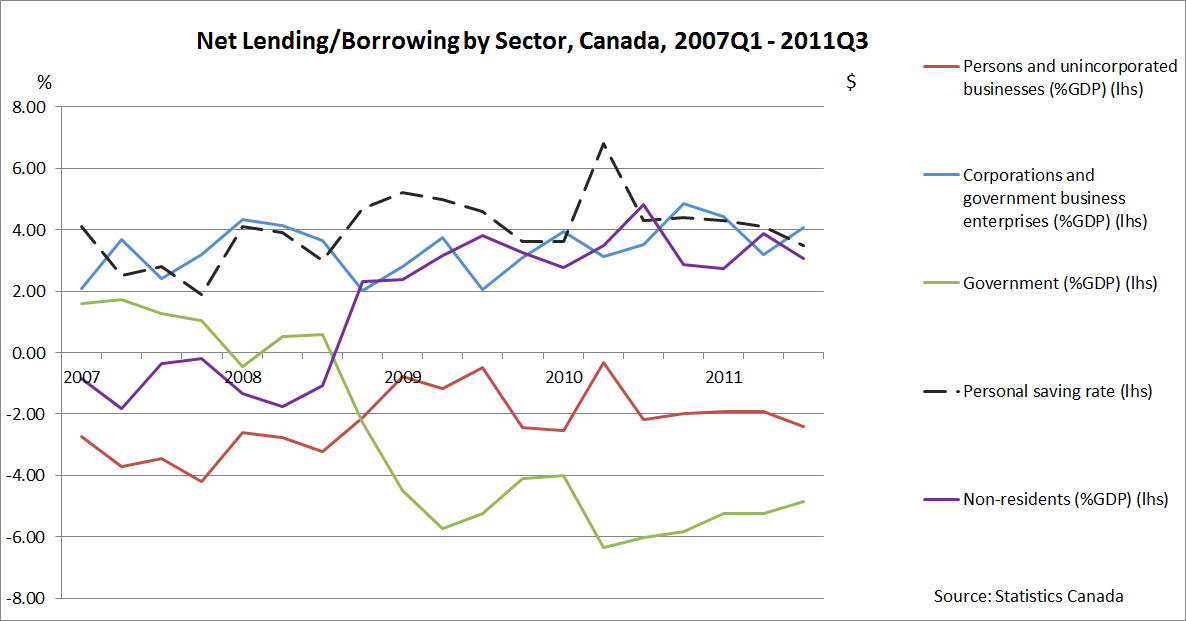
A quick post. The Governor of the Bank of Canada, Mark Carney, gave a speech today on the risks facing Canada and the world economies. While the speech contained many of the same themes covered in the December edition of the Bank's Financial Stability Report released last week (see here), a noticeable emphasis was placed on the issue of Canada's household indebtedness. This is not surprising given that Canada's 2011Q3 National Balance Sheet figures are expected to be released tomorrow.
From a Canadian standpoint, the most important part of the speech was when M. Carney's discussed the different ways in which the net financial deficit of Canada's household sector can be eliminated. According to M. Carney, the deficit of the household sector could be eliminated through a combination of export growth, government spending and business investment.
But it is clear from the speech that M. Carney would prefer that Canada's business sector, which is currently running a significant net financial surplus, take a leading role in helping to stimulate the economy while households are seeking to reduce their level of debt. This approach may sound familiar to regular readers of this website. Here is the relevant excerpt of the speech:
To eliminate the household sector’s net financial deficit would leave a noticeable gap in the economy. Canadian households would need to reduce their net financing needs by about $37 billion per year, in aggregate. To compensate for such a reduction over two years could require an additional 3 percentage points of export growth, 4 percentage points of government spending growth or 7 percentage points of business investment growth.
Any of these, in isolation, would be a tall order. Export markets will remain challenging. Government cannot be expected to fill the gap on a sustained basis.
But Canadian companies, with their balance sheets in historically rude health, have the means to act—and the incentives. Canadian firms should recognize four realities: they are not as productive as they could be; they are under-exposed to fast-growing emerging markets; those in the commodity sector can expect relatively elevated prices for some time; and they can all benefit from one of the most resilient financial systems in the world. In a world where deleveraging holds back demand in our traditional foreign markets, the imperative is for Canadian companies to invest in improving their productivity and to access fast-growing emerging markets. (emphasis added)
Thursday, 8 December 2011
BoC: The euro area is experiencing a recession, deleveraging and fiscal austerity are dampening growth in advanced economies
The Bank of Canada (BoC) released today the December edition of its biannual Financial System Review. The report provides an excellent glimpse of the various trends now affecting the Canadian and world economies.
According to the BoC, the risks to the financial system are similar to those identified in the June report. However, the BoC judges that the overall level of risk has "increased markedly" over the past six months.
The main risks identified by the BoC in the report are:
The section of the report on Canada's increased household indebtedness is particularly noteworthy. As I've previously highlighted, Canada's household debt-to-GDP is currently at a record high. According to the report, the situation could take a turn for the worse in the event of a significant decline in house prices and a sharp deterioration in labour market conditions (p.26). With Canada's unemployment rate increasing, business investment slowing and final domestic demand declining, I view the possibility of these risks materializing as being quite real.
Also, in regard to the situation in Europe, the report mentions that the euro area is now experiencing a recession and correctly points out that a comprehensive policy response is urgently needed to resolve the debt crisis. On this point, the report states:
All in all, the picture drawn in the BoC's report is bleak. Therefore, from a macroeconomic policy standpoint, it would be prudent for federal and provincial governments to abandon efforts to cut public expenditures and reduce fiscal deficits. Rather, governments should prepare for the worse and draw up plans to inject additional stimulus into the economy if the need arises in the coming months.
According to the BoC, the risks to the financial system are similar to those identified in the June report. However, the BoC judges that the overall level of risk has "increased markedly" over the past six months.
The main risks identified by the BoC in the report are:
- the spillovers associated with a further escalation of the European sovereign debt crisis;
- an economic downturn in advanced economies that could be amplified by remaining weaknesses in the balance sheets of global banks;
- a disorderly resolution of global current account imbalances;
- financial stress in the Canadian household sector; and
- a prolonged period of low interest rates, which may encourage imprudent risk-taking and/or erode the long-term soundness of some financial institutions.
The section of the report on Canada's increased household indebtedness is particularly noteworthy. As I've previously highlighted, Canada's household debt-to-GDP is currently at a record high. According to the report, the situation could take a turn for the worse in the event of a significant decline in house prices and a sharp deterioration in labour market conditions (p.26). With Canada's unemployment rate increasing, business investment slowing and final domestic demand declining, I view the possibility of these risks materializing as being quite real.
Also, in regard to the situation in Europe, the report mentions that the euro area is now experiencing a recession and correctly points out that a comprehensive policy response is urgently needed to resolve the debt crisis. On this point, the report states:
The European sovereign debt crisis is acute, but it can be resolved if policymakers address the situation in a forceful manner. European authorities must take steps to restore confidence, which will create time to refound their monetary union based on credible fiscal arrangements and enhanced governance.Finally, the report indicates that an economic downturn in advanced economies
European authorities are working to strengthen the capital of European banks and provide a more reliable funding backstop for euro-area sovereigns. But, judging from the lingering skepticism of investors, bolder action—including clear decisions and firm implementation—is needed to get ahead of the crisis. (p.14)
would have a substantial impact on Canadian businesses, households and financial institutions. While the most obvious channel of transmission would be via the effects of deteriorating credit quality on bank capital bases, these effects could be amplified by significant vulnerabilities in the global economy, including an intensification of funding pressures and of fiscal strains. (p.14) (emphasis added)According to the BoC, the risk described above is judged to be high and has risen since June, owing primarily to the deterioration in the global economic outlook.
All in all, the picture drawn in the BoC's report is bleak. Therefore, from a macroeconomic policy standpoint, it would be prudent for federal and provincial governments to abandon efforts to cut public expenditures and reduce fiscal deficits. Rather, governments should prepare for the worse and draw up plans to inject additional stimulus into the economy if the need arises in the coming months.
Wednesday, 7 December 2011
Functional finance, public capital budgeting and the productivity-enhancing role of public investment
I really enjoy the interviews that the folks at the Institute for New Economic Thinking (INET) have been producing recently. They provide a quick and easy way of learning about new and different approaches to economics.
One interview that I think is particularly interesting from a policy standpoint is the one with economist Mario Seccareccia of the University of Ottawa. The topics discussed during the interview include the pre- and post-crisis approaches to fiscal and monetary policy, functional finance, the financial flows view of macromanagement, public capital budgeting and the productivity-enhancing role of public investment.
Needless to say, I believe the issues discussed in this interview are of fundamental importance to the modern practice of economic policymaking. The part of the interview that I found most interesting is when M. Seccareccia explains the importance of public investment, and the critical role it plays on enhancing productivity.
For those who are interested in knowing more about public capital budgeting, I recommend this excellent short paper by the late economist Richard Musgrave, a pillar in the area of public finance. R. Musgrave's ideas are discussed during the interview.
Reference:
Musgrave, R., "Budget Balance and Sound Finance"
Saturday, 3 December 2011
Canada's 2011Q3 Economic Accounts: federal deficit increases, saving rate drops, growth in real PDI flat
This is a quick post to go over this week's release of Canada's 2011Q3 Economic Accounts and November's Employment report. The title above says it all but here is some added insight.
The increase in the federal government's deficit will no doubt disappoint the federal Minister of Finance, Jim Flaherty. While a growing deficit is a positive development for the economy, as it provides for additional purchasing power, it is very likely that the Minister will attempt to deal with the enlarged deficit by augmenting the level of expenditure cuts he is planning for the upcoming year. Budget plans for next fiscal year are currently being drawn up in Ottawa. Increasing cuts to public expenditures would only worsen the situation and come at a bad time for the economy.
The drop in the saving rate from 4.1 to 3.5 percent will discourage the Governor of the Bank of Canada, Mark Carney. Since early in the recovery, M. Carney has been trying to persuade Canadians to ramp up savings and pay down debt. I doubt that M. Carney still believes this is possible for the near-term: real disposable income has slowed considerably since mid-2010 and Canada's labour market is not faring well at present. And add to the mix the contractionary effects of fiscal measures aimed at reducing the deficit and it is likely that the saving rate will remain low throughout the next year.
Finally, the unemployment rate increased for the second month in a row. It now stands at 7.4 percent, only 0.2 percent lower than in November 2010. With government spending about to decline, business investment down in the third quarter and final domestic demand flat, it is hard to be optimistic about the job market moving forward.
Addendum
The increase in the federal government's deficit will no doubt disappoint the federal Minister of Finance, Jim Flaherty. While a growing deficit is a positive development for the economy, as it provides for additional purchasing power, it is very likely that the Minister will attempt to deal with the enlarged deficit by augmenting the level of expenditure cuts he is planning for the upcoming year. Budget plans for next fiscal year are currently being drawn up in Ottawa. Increasing cuts to public expenditures would only worsen the situation and come at a bad time for the economy.
The drop in the saving rate from 4.1 to 3.5 percent will discourage the Governor of the Bank of Canada, Mark Carney. Since early in the recovery, M. Carney has been trying to persuade Canadians to ramp up savings and pay down debt. I doubt that M. Carney still believes this is possible for the near-term: real disposable income has slowed considerably since mid-2010 and Canada's labour market is not faring well at present. And add to the mix the contractionary effects of fiscal measures aimed at reducing the deficit and it is likely that the saving rate will remain low throughout the next year.
 |
| Click on image to enlarge |
Finally, the unemployment rate increased for the second month in a row. It now stands at 7.4 percent, only 0.2 percent lower than in November 2010. With government spending about to decline, business investment down in the third quarter and final domestic demand flat, it is hard to be optimistic about the job market moving forward.
 |
| Unemployment rate, Source: Statistics Canada |
Addendum
 |
| Click on image to enlarge |
Saturday, 26 November 2011
Deficit myths (Part 3): The effect of budget deficits on business profits
Martin Wolf is right in saying that government fiscal tightening will hurt business profits. As Wolf correctly points out: "In order to reduce huge government deficits, surpluses must fall elsewhere".
For the UK, this means that the only way the government can succeed in balancing its budget is if the reduction in the government deficit is offset by a reduction of equivalent magnitude in the surplus of at least one other sector of the economy (i.e. household, corporate or foreign sector). And according to Wolf, the surplus sector that is most likely to be affected by the government's plan to reduce the deficit is the corporate sector because, at the moment, the household sector is not willing to incur additional debt (and fall back into deficit) and UK exporters are unlikely to reverse the flow of wealth currently exiting the UK economy (thereby reducing the surplus of foreigners).*
In a way, Wolf could just easily have argued that, in the UK right now, it is the government deficit that is enabling the corporate sector to run a surplus. And when households are deleveraging and exports are declining, business profits can only be realized if the government runs a deficit. Thus, by cutting the deficit, the government is in effect reducing an important source of business profits.
Proof of this direct, positive relationship between government deficits and business profits is best demonstrated by manipulating the basic national income accounting identity in a manner consistent with the approach of economists John Maynard Keynes and Michal Kalecki. The following arithmetic demonstrates that government deficits have a positive effect on business profits.
Let Y=Total Output; C=Consumption; I=Investment; G=Government Expenditures; X=Exports; M=Imports; T=Taxes; R=Retained Earnings by Firms; Hs=Household Net Savings
Let the combination of the above (X - M) = Current Account Balance or Net Exports; (G - T) = Government Deficit; (Hs + R) = (Y - T - C) = Total Net Private Savings
To start off, here is the basic national income identity, as taught in all macroeconomic textbooks:
Y = C + I + G + (X - M)
Subtract taxes (from both sides of the equation) to achieve an equation "net" of taxes:
Y - T = C + I + G + (X - M) - T
Rearrange the equation to isolate total net private savings on the left side and to subtract taxes from government expenditures:
Y - T - C = I + (G - T) + (X - M)
Since (Y - T - C) can be broken down into household net savings (Hs) and retained earnings by firms (R), the equation can be stated as follows (see Krugman, 1994:313):
(Hs + R) = I + (G + T) + (X - M)
...and can be rearranged as such:
R = (I - Hs) + (G - T) + (X - M)
In plain English, this translates into:
Firms' Retained Earnings = Investment - Household Savings + Government Deficits + Net Exports
The above equation clearly demonstrates that business profits are positively impacted by government deficits, net exports and private sector investment.* Household net savings, on the other hand, have the effect of reducing firms' retained earnings. Similarly, balanced budgets and government surpluses have either no impact on profits or have the effect of reducing them.
One objection to this line of reasoning often invoked by economists is that government deficits increase the level of private sector savings (as households and businesses reduce consumption in anticipation of future tax increases). This claim is known as the Ricardian Equivalence proposition. However, there is little empirical evidence that this claim holds true and that the impact of government deficits gets neutralized (or offset) by a corresponding increase in private sector savings. As Douglas Bernheim argued in his seminal work on the topic:
* Paul McCulley provided a similar analysis (2010).
** A different, yet equally effective approach to examining the relationship between profits and government deficits is found in Levy et al. (2008:16).
References
Bernheim, D., "Ricardian Equivalence: An Evaluation of Theory and Evidence", NBER Macroeconomics Annual 1987, S. Fischer, ed., Vol. 2, pp. 263-316, (Mass: MIT Press), 1987
Krugman, P., International Economics: Theory and Policy 3rd Ed., (New York:Harper-Collins), 1994
Levy, D., et al., Where Profits come from? Answering the Critical Question that Few Ever Ask, The Jerome Levy Forecasting Center, LLC, 2008
McCulley, P., Facts on the ground, Policy Note, Levy Institute of Bard College, 2010
For the UK, this means that the only way the government can succeed in balancing its budget is if the reduction in the government deficit is offset by a reduction of equivalent magnitude in the surplus of at least one other sector of the economy (i.e. household, corporate or foreign sector). And according to Wolf, the surplus sector that is most likely to be affected by the government's plan to reduce the deficit is the corporate sector because, at the moment, the household sector is not willing to incur additional debt (and fall back into deficit) and UK exporters are unlikely to reverse the flow of wealth currently exiting the UK economy (thereby reducing the surplus of foreigners).*
In a way, Wolf could just easily have argued that, in the UK right now, it is the government deficit that is enabling the corporate sector to run a surplus. And when households are deleveraging and exports are declining, business profits can only be realized if the government runs a deficit. Thus, by cutting the deficit, the government is in effect reducing an important source of business profits.
Proof of this direct, positive relationship between government deficits and business profits is best demonstrated by manipulating the basic national income accounting identity in a manner consistent with the approach of economists John Maynard Keynes and Michal Kalecki. The following arithmetic demonstrates that government deficits have a positive effect on business profits.
Let Y=Total Output; C=Consumption; I=Investment; G=Government Expenditures; X=Exports; M=Imports; T=Taxes; R=Retained Earnings by Firms; Hs=Household Net Savings
Let the combination of the above (X - M) = Current Account Balance or Net Exports; (G - T) = Government Deficit; (Hs + R) = (Y - T - C) = Total Net Private Savings
To start off, here is the basic national income identity, as taught in all macroeconomic textbooks:
Y = C + I + G + (X - M)
Subtract taxes (from both sides of the equation) to achieve an equation "net" of taxes:
Y - T = C + I + G + (X - M) - T
Rearrange the equation to isolate total net private savings on the left side and to subtract taxes from government expenditures:
Y - T - C = I + (G - T) + (X - M)
Since (Y - T - C) can be broken down into household net savings (Hs) and retained earnings by firms (R), the equation can be stated as follows (see Krugman, 1994:313):
(Hs + R) = I + (G + T) + (X - M)
...and can be rearranged as such:
R = (I - Hs) + (G - T) + (X - M)
In plain English, this translates into:
Firms' Retained Earnings = Investment - Household Savings + Government Deficits + Net Exports
The above equation clearly demonstrates that business profits are positively impacted by government deficits, net exports and private sector investment.* Household net savings, on the other hand, have the effect of reducing firms' retained earnings. Similarly, balanced budgets and government surpluses have either no impact on profits or have the effect of reducing them.
One objection to this line of reasoning often invoked by economists is that government deficits increase the level of private sector savings (as households and businesses reduce consumption in anticipation of future tax increases). This claim is known as the Ricardian Equivalence proposition. However, there is little empirical evidence that this claim holds true and that the impact of government deficits gets neutralized (or offset) by a corresponding increase in private sector savings. As Douglas Bernheim argued in his seminal work on the topic:
...the case for long-run neutrality is extremely weak, in that it depends upon improbable assumptions that are either directly or indirectly falsified through empirical observation...[B]ehavioral evidence weighs heavily against the Ricardian view (1987:213)To conclude, it should be emphasized that the purpose of economic policy is not to enable firms to realize profits, but to maximize employment and ensure that the product of industry is beneficial to the overall economy. Business profits, by creating an incentive for firms to invest and employ available resources, can help to promote these objectives. In the above analysis, my aim is to show that government deficits cannot be looked at in isolation from the financial positions of other sectors of the economy. Whether it is to stabilize aggregate demand or to provide for much needed public goods, deficits serve an important purpose. Attempting to reduce government deficits without considering its impact on the overall economy is not a sound basis for policy.
* Paul McCulley provided a similar analysis (2010).
** A different, yet equally effective approach to examining the relationship between profits and government deficits is found in Levy et al. (2008:16).
References
Bernheim, D., "Ricardian Equivalence: An Evaluation of Theory and Evidence", NBER Macroeconomics Annual 1987, S. Fischer, ed., Vol. 2, pp. 263-316, (Mass: MIT Press), 1987
Krugman, P., International Economics: Theory and Policy 3rd Ed., (New York:Harper-Collins), 1994
Levy, D., et al., Where Profits come from? Answering the Critical Question that Few Ever Ask, The Jerome Levy Forecasting Center, LLC, 2008
McCulley, P., Facts on the ground, Policy Note, Levy Institute of Bard College, 2010
Monday, 21 November 2011
Crescenzi watch: Public investments boost our standard of living
In a previous post, I criticized Tony Crescenzi, author of PIMCO's Global Central Bank Focus column, for depicting Keynesian-inspired policy remedies as wasteful and ineffective. So I was surprised to discover that the November edition of Crescenzi's column contains one of the most spirited pleas in favor of increased public investment that I have read in recent weeks.
Here is an excerpt from Crescenzi's column,
Here is an excerpt from Crescenzi's column,
The vigor and verve with which Franklin Delano fought the Depression today is sorely lacking in Washington, which through its self-aggrandizing and ignorance spits with contempt at fires that rage across the U.S. economic landscape, leading Americans to feel anxious and helpless. This anxiety is present throughout the world, which perceives U.S. leadership to be adrift and intensely polarized. The same goes for European leaders. [...]
U.S. policymakers made one of their first serious blunders in this crisis in 2009 when they crafted an economic stimulus plan targeting consumption rather than investment. The benefits of the stimulus therefore faded rather quickly, which is to say the stimulus had a low or negative fiscal multiplier. The money would have been better spent on investments, which tend to have longer-lasting benefits that boost the national standard of living.
Consider this example. When Uncle Sam divvies out stimulus checks to consumers it leads to increased purchases of pants, socks, shoes, a hamburger, a garden hose, you name it, but the purchase of these and other everyday essentials do nothing for America’s long-run growth potential. Investments, on the other hand, have longer-lasting benefits. Consider the benefit of investing in a highway, or an energy grid – it lasts years. In other words, an investment of this sort has a relatively high fiscal multiplier – it is the gift that keeps on giving. (emphasis added)
I agree entirely with this view of public investment. In fact, the papers by economists David Aschauer and Alicia Munnell linked to my previous post support the claim that public investment results in a net benefit to society in the long-run.
That said, I am a somewhat puzzled by Crescenzi's contention that the recent US federal stimulus did not significantly enhance the level of public investment. As you can see from the charts below, whether you look at total (federal, state and local) nondefense public investment as a percentage of gross domestic product (Chart 1) or public investment as a percentage of private nonresidential investment (Chart 2), the US federal stimulus initiated at the onset of the last recession resulted in a very large increase in public investment.
Finally, in regard to Crescenzi's point about public investment being more effective than measures that boost private consumption, one could argue that government intervention aimed at increasing private consumption is not necessarily detrimental if it is accompanied by a decline in household indebtedness (see Chart 3). As the great economist and disciple of Keynes, Lorie Tarshis, once wrote in relation to remedies for recession (or Depression):
Reference
Tarshis, L., The Elements of Economics (Riverside Press: Cambridge), 1947
That said, I am a somewhat puzzled by Crescenzi's contention that the recent US federal stimulus did not significantly enhance the level of public investment. As you can see from the charts below, whether you look at total (federal, state and local) nondefense public investment as a percentage of gross domestic product (Chart 1) or public investment as a percentage of private nonresidential investment (Chart 2), the US federal stimulus initiated at the onset of the last recession resulted in a very large increase in public investment.
 |
| Chart 1: Public investment as a percentage of GDP, Source: St. Louis Fed |
 |
| Chart 2: Public investment as a percent of private investment, Source: St. Louis Fed |
Finally, in regard to Crescenzi's point about public investment being more effective than measures that boost private consumption, one could argue that government intervention aimed at increasing private consumption is not necessarily detrimental if it is accompanied by a decline in household indebtedness (see Chart 3). As the great economist and disciple of Keynes, Lorie Tarshis, once wrote in relation to remedies for recession (or Depression):
The general objective is clear: to increase employment, we must either increase the propensity to consume or increase investment. And, as a matter of fact, there is no reason why we should not try to increase both. (1947:570) (emphasis added)But, on the whole, I am willing to agree with Crescenzi that, given the current state of US public infrastructure, increasing public investment would be more beneficial than measures aimed at increasing consumption.
 |
| Chart 3: Financial Obligations and Debt service to income, Source: St. Louis Fed |
Reference
Tarshis, L., The Elements of Economics (Riverside Press: Cambridge), 1947
Wednesday, 16 November 2011
Inflation-targeting: Still the BoC's top priority
It's a shame this sort of discussion didn't occur during the last federal election. A debate on the renewal of the Bank of Canada's inflation-control target would have added much substance to what I thought was a particularly lame election. But what is even more regretful is that this discussion, it now turns out, got to take place only after the renewal of the five-year agreement became a fait accompli.
That said, yesterday's session of the House of Commons Standing Committee on Finance aimed at discussing the merits of the renewal of the BoC's inflation target contained some good exchanges. The economists who were invited to present their views included Mario Seccareccia of the University of Ottawa, Scott Sumner of Bentley University, Jim Stanford of the Canadian Auto Workers Union, Chris Ragan of McGill University and Craig Alexander of TD Bank.
I was particularly pleased by the fact that the discussions were not limited to the renewal of the inflation target. Topics also touched upon included the role of fiscal policy, the current slowdown in the global economy, the actions of the Bank of Canada in recent years, as well as the state of Canada's manufacturing sector.
My views on the BoC's inflation target can be found here and here. Given that this type of conversation only occurs once every five years, I thought it might be appropriate to post it here (click on Play to hear the session) Enjoy.
Subscribe to:
Posts (Atom)